Thursday, July 28, 2011

Native Irish Plants for Winter

I've been listening to the BBC Gardeners' Question Time podcast of late, and also looking at gardens while I commute. The harsh winter of 2010-2011 seems to have ravaged gardens up and down the British Isles, and this is clear in two ways.

First, nigh-on every every episode of GQT has a question like "My beloved such-and-such plant died over the winter; can you suggest a replacement?". Second, gardens all over Ireland have dead shrubs standing out - sometimes it's just one set of bare branches, but there's one garden near us that has a hedge, three large shrubs, and several lower and smaller ones, all stone dead. There's a honeysuckle growing over one of the big dead shrubs, which gives the garden some semblance of life, but otherwise it looks like some sort of depressing art installation.

The GQT folks have a barrage of suggestions, but they come down to one fundamental - use native plants. We may think that winters like the last two are unusual, but the plant life of the British Isles disagrees, and can handle the -15°C fairly well. The exotics, on the other hand, keel over - there are dead palm trees hither and yon all over the South-west of Ireland, for just one example. Now, there are exotics I have every intention of growing, but they're either tolerant of our climate - pak choi, for instance, which is so happy in cold damp conditions that the crop I planted this year reckoned it was too dry, and bolted - or kept in greenhouses, like the jalapeƱo peppers we're hoping to have a crop from this autumn.

There were two palm trees in our place when we moved in; one at the front, and one at the back. They were terminated with extreme prejudice. Everything else shrub-like or hedging in there is native, or hardy - hazel, holly, blackthorn, hawthorn, ash, and so on. The only thing in the whole place that didn't make it through the winter intact was the rosemary in the herb bed.

So it's pretty clear that native plants have a massive advantage in this regard over the exotics. Now if only the weather could kill off bindweed.

Wednesday, July 27, 2011

Asparagus

Two years ago, I planted asparagus crowns. I noted earlier this year that they seemed to have died; this turns out to be incorrect. There is, once more, one solitary frond of very narrow asparagus hanging out where the three crowns went in. This, to be honest, almost more frustrating than the things having died off completely.

Now, having concluded they were dead, that area hasn't been weeded, so that's probably not doing it any favours. It's halfway covered in vetch, for a start. But even if I weed it thoroughly and carefully, I'm not sure what to do to actually encourage the plant. More compost? Dig it up and move it somewhere else?

Some initial research seems to indicate that compost is indeed the way to go, but also argues for a well-drained sandy loam, rather than our cold clay. So I'm reckoning that if I want to keep this one, I'll look at clearing it up carefully, leaving the fern there over the winter, and providing it with a good dollop of compost in the autumn. But it does seem like a small raised bed elsewhere with some more suitable soil brought in might be a better solution - it'll warm sooner in the spring, drain better, and be somewhat easier to keep weed free. I do have a bunch of beams left from the attic, so I could build a nice high bed.

Monday, July 25, 2011

Crops, July 2011

Some pictures of the crops growing in the garden this summer.

The lettuces are starting to go to seed a little - we've more coming up, so it's not a problem, and they've done very well as cut-and-come-again crops. Also, they're gorgeously geometric when they run to seed, so I'm willing to let them be for a bit on that stake as well.

The apples are getting sizable enough. There are six on this tree, and two on the other; after the whipping around in wind they got in late April, I'm not unhappy with that, and they're young trees yet.

The peas have come into their own in the last couple of weeks; there are fattening pods all over. We've had some, and they were very good, and I look forward to more soon. Oddly, the ones in newer, unimproved ground did well (or maybe it was something to do with the rogue potatoes alongside them), while those in better ground are much slower to get going.

And then the green beans, which were extremely poor at the germination stage. But all three plants that actually sprouted have done very well, and are now being trained up the cones. They're just short of flowering, so with any luck, we'll have a crop from them as well.

Next year, I reckon I'll be doing a lot more planting in trays and then planting out; much better control over conditions starting out, and a lot less bother with thinning. And they'll look neater too.

Saturday, July 23, 2011

Second-hand Greenhouse (Miniature)

Friends who are moving out of the country said we could have their miniature greenhouse. Having assembled a makeshift one from old windows and attic beams, I wasn't about to say no. It needed some dis-assembly to get in it as far as the car, and then we realised that the size of the back panel - composed of solid pine beams and tongue-and-groove boards - meant it just wasn't going to go in, and that was it. So out came a hammer, and I took it apart, plank by plank, until it fitted.

Re-assembly therefore meant starting with remaking the back panel, and that started with taking out the rusty staples it had been put together with. Between a hammer to knock them flat in places, and a pliers to get them out where possible, I eventually got them all dealt with. And then on to the assembly. There's something very pleasing about working outdoors with wood on a sunny day.

Here's the final result:


That's now sitting at the back of the house, holding two tomato plants (one starting to groan with green tomatoes, the other only starting to produce a few; both have lots more flowers), a jalapeno pepper (flowers, no fruit yet, but I'm hopeful), and a small grape-vine, which we thought was dead, but has started to produce some small leaves again. Ideally, I think, it should actually be in soil, with a wall to climb on, but it's very small right now, and I think a year's coddling before we expose it to the outside world might be good for it.

One thing I would like to get would be a couple of small thermometers, which I'd mount where they can be seen in this and in the makeshift one. I reckon this will be hotter than the recycled one, so that gives three stages of heat - outside, recycled greenhouse, and good greenhouse, in increasing heat.

Friday, July 22, 2011

Attic Progress

The attic work is under way, and it's going well. We pulled out the fitted wardrobe - which took a little longer than expected, because whoever fitted it had some of fetish about using lots and lots of nails. The removed chipboard and plasterboard are going into a skip, which arrived yesterday, and will be filled up tomorrow. The more solid bits of actual timber that were forming the structure, I'm hanging on to; some of them have already become the frame of a miniature greenhouse, and the rest will find uses in the garden.

The next bit was putting down flooring. First, though, it was necessary to raise the level a bit, as there are lots of wires, pipes, and other bits that cross the actual rafters. The optimal height to raise it was exactly 5cm, but annoyingly, this falls short of the floor level in the bedroom, since the bedroom floor is on thicker, deeper rafters. I looked into what I'd need to do to make the floors match in level, but it would have been difficult, and made the overall structure rather weaker than I was happy with. So there are 5cm square beams crossing the rafters at right angles, about 35cm apart, and the high-density particleboard "loft panels" rest on these. There were support beams, wires, and other things to navigate around, and by and large, it has come out very neatly. There are a few more bits to slot in, but that's waiting on the replacement jigsaw blades I bought this morning.

We had a local electrician in to lay cables for the sockets and light fittings, and those have been accommodated as well. The cables will disappear behind panelling of one kind or another when everything is finished. Once everything else is in place, the electrician will come back in to do the final fittings.

Since there's a support beam at ceiling level as well, the old opening for the fitted wardrobe is becoming the opening into the new space - a doorway without a door. This will become a feature, and I plan to put a nice timber step - only a centimetre or two high - in the opening to allow for the difference in floor levels.

We're also putting up a hardboard ceiling - this won't be the final surface; it's just to keep the insulation material at bay for now. It's about two-thirds in place, and is awaiting the jigsaw blades as well before it can be finished.

The next bit will be to put in the storage. There are various details to work around with this, as there were with the flooring; beams and access to the water tank being the main ones. Once I'm done with the floor and ceiling, I can start to measure and calculate how we can get the most storage out of the space that's there. Long drawers and pull-out rails will certainly feature. The spare mattresses, which were such a nuisance to get in and out before, are being disposed of; we got a chair-bed for the study downstairs, and we'll get an air mattress or two in case of extra need. Not having those will free up a lot of storage, and put less constraint on what we can do.

And when all of that is in place, we'll finish it out with tongue-and-groove panelling, as in the bathroom downstairs, and put something a bit nicer on the floor.

Wednesday, June 8, 2011

Long Term Planting Plans

I'm giving some consideration now to long-term planting plans for the garden. There are a number of crops which don't really partake of crop rotation in any form, given that they're the same plants for a number of years. The fruit trees and bushes are one example of this, but there're also the strawberries, which will be in place for at least three years, and the potential for rhubarb and asparagus.

I tried to plant asparagus before, but it didn't work out well - there was one single fern from the three I planted, and then nothing the following year. I'm not sure whether the soil was to blame (a fair chance), or my possibly inept planting (also a fair chance). The fact that I wasn't 100% sure what an asparagus fern looked like was of no help in this.

The two apples we have, and the pear, are at the back of the garden, and except in the height of summer, they're in the shade of the south wall at noon. They get some sun in mid-morning, and a little in the evening. As they grow higher, of course, this to being less of a problem, and to be honest, they don't seem to suffer much from it even now. They're quite close together, but as long as they're kept pruned back to reasonable sizes, they should be fine. I did see apple trees at the Bloom festival last weekend which were plainly twenty years old or more, but which were not much taller than ours now - they'd been kept trimmed back very nicely, giving an effect almost like bonsai.

Some of the fruit bushes - particularly the gooseberry - are coming into their own. I'm debating not pruning the smallest currant this year - it looks like it could use some more physical mass - but I'm honestly not sure whether that's better or worse for it. I'll have to do some reading.

And then there's the aforementioned rhubarb and asparagus. I need to work out what they need, when the ideal time of year is to plant them, and then find suitable spaces in the garden that I can be relatively sure won't be disturbed for a number of years. My instinctive urge is to have them near the edges, but that's not necessarily useful, or even convenient - why shouldn't there be a great big bed of rhubarb in the middle of the garden? Indeed, given we've a slightly inconveniently located plum tree, I could do worse than plant rhubarb around it.

Wednesday, May 25, 2011

Attic Plans

We have plans for the attic. While our house has an upper story, it's all within the roof - there's only one room up there, and the one window is in the gable wall. The room doesn't occupy all of the attic space, though - it goes from where the height rises to about one metre on one side to where it falls to about 1.5m on the other side. Now, that's uneven - because there's a section of actual "attic" there too, accessed through a door in the back of a built-in wardrobe. It's bare rafters at floor level - you put your foot through onto the plasterboard ceiling of the sitting room - and insulation more-or-less held in place with a sheet of clear plastic tacked to the roof rafters.

The access doorway is very narrow, and it's a pain in the neck (and sides, leg, and some other parts) to get anything large through, because once you're through, you have to twist the thing or hit the roof pretty much immediately. It's also partly full of stuff - spare mattresses, boxes of seasonal decorations, and stuff in storage for a charity bring-and-buy stall we run at conventions.

The plan is, essentially, to take out the dividing wall entirely, or as much as possible, and extend the bedroom floor and ceiling down into that space. We can then put screens or a curtain or something across where the wall was, if need be, but mostly it'll be storage space. A skylight will let in some light, the mattresses can lie flat, and we might even get a small desk or the like in there as well. And it'll be a matter of walking in, crouching a bit at the far side, but no more struggling through the narrow access door - and it'll make the master bedroom about 30% bigger.

The upstairs floor is chipboard under the carpet, and I think we'll replicate that in the soon-t0-be-ex-attic space; we can put down something nicer over it later on. The ceiling will almost certainly be tongue-and-groove panelling, which we both like, and which worked well in the bathroom. I'll need to leave access to the water storage tanks, but that can be behind a door, or maybe even a hinged set of shelves - access there won't be needed often.

A light fitting, or maybe some wall-mounted lamps, a socket or four, and it'll be a very nice extra space.

Wednesday, May 18, 2011

Fruit in the Garden

We're starting to see fruit in the garden. Here, for example, are the gooseberries:

The bush was planted two years ago, but hasn't really fruited properly. It looks like it's changing that this year, and we're planning to let it grow out as much as it likes for next year, so we should have an even better crop then.

The apple trees also have little applets on:


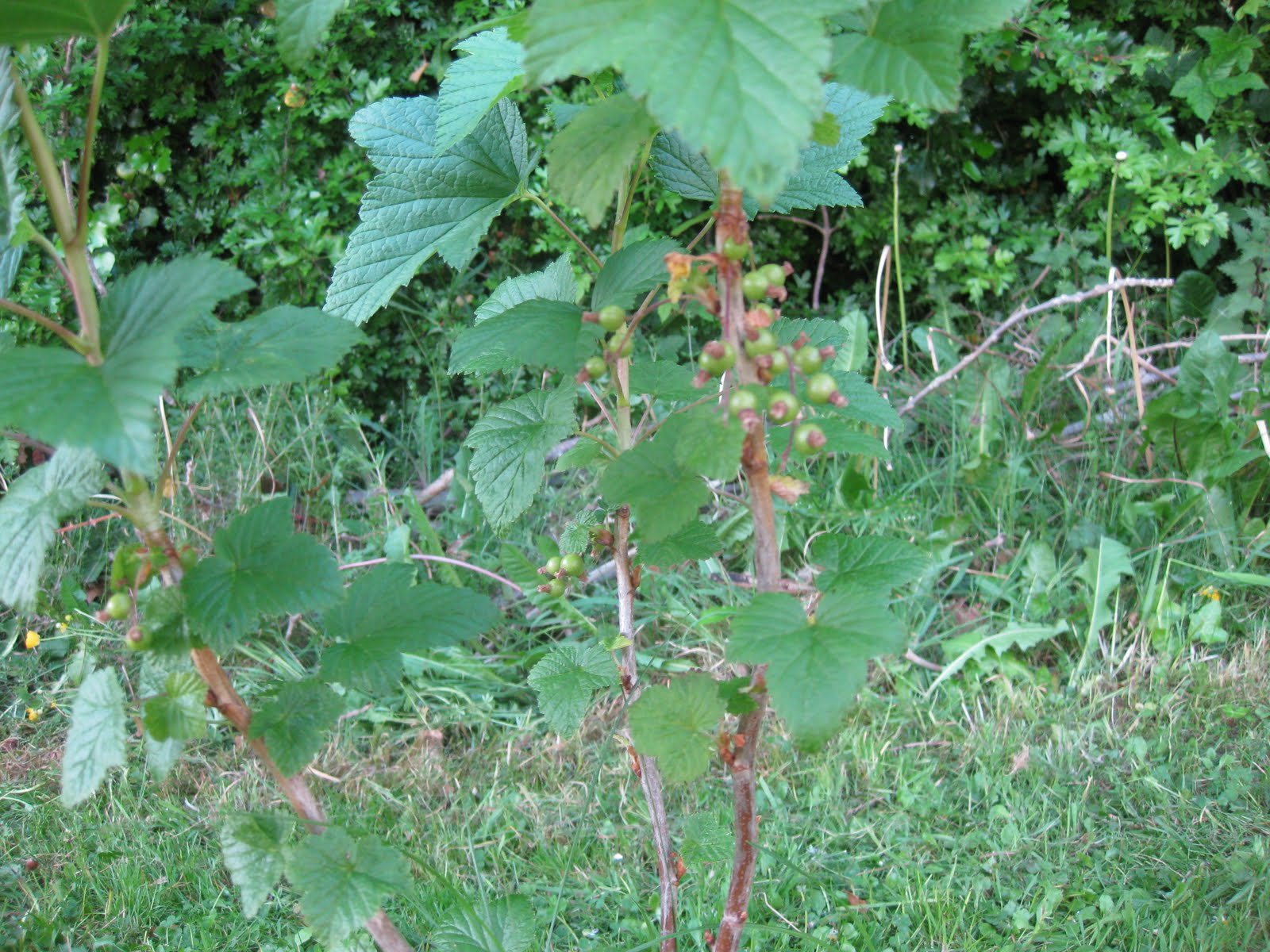
And even the currants are going well. This is one bush of the four in the garden, which are of varying sizes and shapes, and in varying conditions. If they go the way the gooseberry is going, we should have a good-sized crop over the next few years too.

The Fat Cat is not a fruit, but she's very comfortable in this picture, and a comfortable cat is one who is not winding around your ankles to trip you, or digging in the onion bed:


Herb Bed

The herb bed has been doing very well indeed. The glass panel in the foreground below covers the basil and some coriander, and there's another in at the back, between the two parsley plants, which covers more coriander. There's also some rosemary tucked in there, but it's hard to make out - it's just behind the foreground glass panel.

Getting Rid of An Ash Tree Stump

So, we brought that tree down last year. I'm actually having some trouble finding an image of the garden with it in, and considering the number of pictures I've taken, that seems bizarre. However, this entry has an image of the garden under snow, with the tree right in the middle.

Here's the view from earlier this year, with the stump visible in the midst of other work. It's barely visible, really, having been chopped off within about six inches of ground level.


So, after it was chopped down, we excavated around it, looking to unearth it, chop off the roots, and basically dig it up. This proved harder than expected, because there were big stones all around it - it seems it grew on the remnants of a dry-stone wall.

Eventually, we got it to a stage where we'd cleared all around it, leaving a big hole with the stump in the middle.


The trouble was that we weren't able to unearth it. It just kept going down, and down, and down. And my chainsaw was basically bouncing off it. Having tried to get the chain sharpened, and finding that it was too worn to do so, I arranged for someone to come in with a chainsaw and hack the thing out of there.

However, even for a professional with an industrial chainsaw, it wouldn't budge. He got an 8-inch slice off the top, which dropped it to below ground level, but below that, it was considerably harder than was in any way reasonable for an ash. The chainsaw was basically grinding at it, raising a lot of smoke, and getting nowhere.

So we settled for boring a lot of holes in the top, so that it can rot down. We could have put some petrol in, fired it, and repeated over a few months, gradually breaking it down, but frankly, a petrol-fuelled fire in the back yard did not appeal.


So we buried it. I brought out over the frame from an old raised bed from last year, filled in around the stump with the piles of soil we'd dug out - and about three-quarters of the compost-heap under where I'll be planting some squash.

And here's how it looks now, with no tree and no stump. I'm very glad to see the back of it, and while we won't be able to plant root vegetables in that bed for a while yet, it'll do nicely for strawberries or the like.