Wednesday, June 8, 2011

Long Term Planting Plans

I'm giving some consideration now to long-term planting plans for the garden. There are a number of crops which don't really partake of crop rotation in any form, given that they're the same plants for a number of years. The fruit trees and bushes are one example of this, but there're also the strawberries, which will be in place for at least three years, and the potential for rhubarb and asparagus.

I tried to plant asparagus before, but it didn't work out well - there was one single fern from the three I planted, and then nothing the following year. I'm not sure whether the soil was to blame (a fair chance), or my possibly inept planting (also a fair chance). The fact that I wasn't 100% sure what an asparagus fern looked like was of no help in this.

The two apples we have, and the pear, are at the back of the garden, and except in the height of summer, they're in the shade of the south wall at noon. They get some sun in mid-morning, and a little in the evening. As they grow higher, of course, this to being less of a problem, and to be honest, they don't seem to suffer much from it even now. They're quite close together, but as long as they're kept pruned back to reasonable sizes, they should be fine. I did see apple trees at the Bloom festival last weekend which were plainly twenty years old or more, but which were not much taller than ours now - they'd been kept trimmed back very nicely, giving an effect almost like bonsai.

Some of the fruit bushes - particularly the gooseberry - are coming into their own. I'm debating not pruning the smallest currant this year - it looks like it could use some more physical mass - but I'm honestly not sure whether that's better or worse for it. I'll have to do some reading.

And then there's the aforementioned rhubarb and asparagus. I need to work out what they need, when the ideal time of year is to plant them, and then find suitable spaces in the garden that I can be relatively sure won't be disturbed for a number of years. My instinctive urge is to have them near the edges, but that's not necessarily useful, or even convenient - why shouldn't there be a great big bed of rhubarb in the middle of the garden? Indeed, given we've a slightly inconveniently located plum tree, I could do worse than plant rhubarb around it.

Wednesday, May 25, 2011

Attic Plans

We have plans for the attic. While our house has an upper story, it's all within the roof - there's only one room up there, and the one window is in the gable wall. The room doesn't occupy all of the attic space, though - it goes from where the height rises to about one metre on one side to where it falls to about 1.5m on the other side. Now, that's uneven - because there's a section of actual "attic" there too, accessed through a door in the back of a built-in wardrobe. It's bare rafters at floor level - you put your foot through onto the plasterboard ceiling of the sitting room - and insulation more-or-less held in place with a sheet of clear plastic tacked to the roof rafters.

The access doorway is very narrow, and it's a pain in the neck (and sides, leg, and some other parts) to get anything large through, because once you're through, you have to twist the thing or hit the roof pretty much immediately. It's also partly full of stuff - spare mattresses, boxes of seasonal decorations, and stuff in storage for a charity bring-and-buy stall we run at conventions.

The plan is, essentially, to take out the dividing wall entirely, or as much as possible, and extend the bedroom floor and ceiling down into that space. We can then put screens or a curtain or something across where the wall was, if need be, but mostly it'll be storage space. A skylight will let in some light, the mattresses can lie flat, and we might even get a small desk or the like in there as well. And it'll be a matter of walking in, crouching a bit at the far side, but no more struggling through the narrow access door - and it'll make the master bedroom about 30% bigger.

The upstairs floor is chipboard under the carpet, and I think we'll replicate that in the soon-t0-be-ex-attic space; we can put down something nicer over it later on. The ceiling will almost certainly be tongue-and-groove panelling, which we both like, and which worked well in the bathroom. I'll need to leave access to the water storage tanks, but that can be behind a door, or maybe even a hinged set of shelves - access there won't be needed often.

A light fitting, or maybe some wall-mounted lamps, a socket or four, and it'll be a very nice extra space.

Wednesday, May 18, 2011

Fruit in the Garden

We're starting to see fruit in the garden. Here, for example, are the gooseberries:

The bush was planted two years ago, but hasn't really fruited properly. It looks like it's changing that this year, and we're planning to let it grow out as much as it likes for next year, so we should have an even better crop then.

The apple trees also have little applets on:


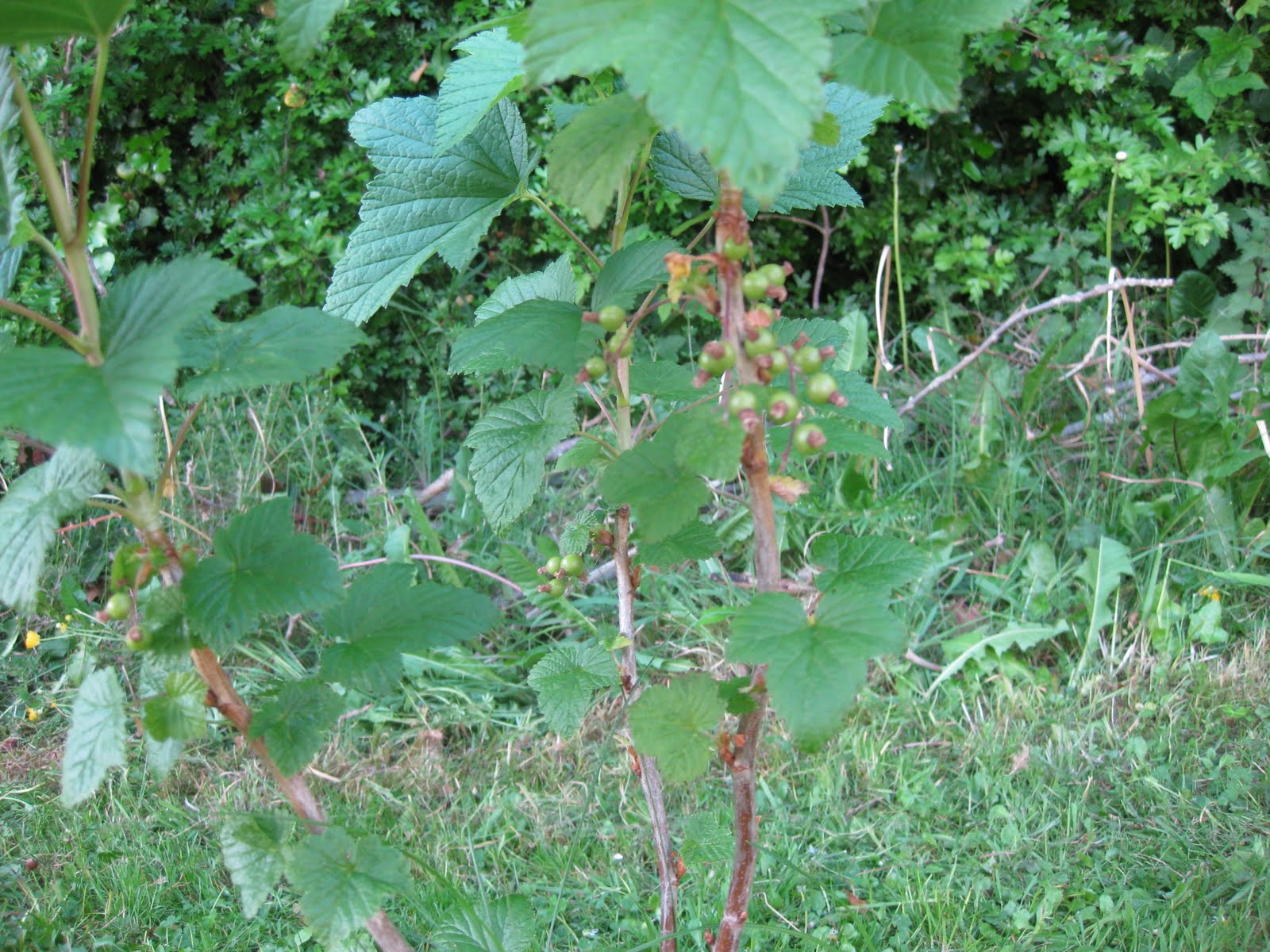
And even the currants are going well. This is one bush of the four in the garden, which are of varying sizes and shapes, and in varying conditions. If they go the way the gooseberry is going, we should have a good-sized crop over the next few years too.

The Fat Cat is not a fruit, but she's very comfortable in this picture, and a comfortable cat is one who is not winding around your ankles to trip you, or digging in the onion bed:


Herb Bed

The herb bed has been doing very well indeed. The glass panel in the foreground below covers the basil and some coriander, and there's another in at the back, between the two parsley plants, which covers more coriander. There's also some rosemary tucked in there, but it's hard to make out - it's just behind the foreground glass panel.

Getting Rid of An Ash Tree Stump

So, we brought that tree down last year. I'm actually having some trouble finding an image of the garden with it in, and considering the number of pictures I've taken, that seems bizarre. However, this entry has an image of the garden under snow, with the tree right in the middle.

Here's the view from earlier this year, with the stump visible in the midst of other work. It's barely visible, really, having been chopped off within about six inches of ground level.


So, after it was chopped down, we excavated around it, looking to unearth it, chop off the roots, and basically dig it up. This proved harder than expected, because there were big stones all around it - it seems it grew on the remnants of a dry-stone wall.

Eventually, we got it to a stage where we'd cleared all around it, leaving a big hole with the stump in the middle.


The trouble was that we weren't able to unearth it. It just kept going down, and down, and down. And my chainsaw was basically bouncing off it. Having tried to get the chain sharpened, and finding that it was too worn to do so, I arranged for someone to come in with a chainsaw and hack the thing out of there.

However, even for a professional with an industrial chainsaw, it wouldn't budge. He got an 8-inch slice off the top, which dropped it to below ground level, but below that, it was considerably harder than was in any way reasonable for an ash. The chainsaw was basically grinding at it, raising a lot of smoke, and getting nowhere.

So we settled for boring a lot of holes in the top, so that it can rot down. We could have put some petrol in, fired it, and repeated over a few months, gradually breaking it down, but frankly, a petrol-fuelled fire in the back yard did not appeal.


So we buried it. I brought out over the frame from an old raised bed from last year, filled in around the stump with the piles of soil we'd dug out - and about three-quarters of the compost-heap under where I'll be planting some squash.

And here's how it looks now, with no tree and no stump. I'm very glad to see the back of it, and while we won't be able to plant root vegetables in that bed for a while yet, it'll do nicely for strawberries or the like.


Tuesday, April 26, 2011

Seeds Planted in April

So, we got more digging done, built a low wall behind the herb bed with some of the stones that came from under the tree stump, and then got things planted. This post is as much a record of what went in when as it is an actual blog post, but it does mean I can find the details again.

So, the following were sown on Saturday, April 23rd: Potatoes (Organic Sarpo Mira), Onions (Bedfordshire Champion - from seed, not sets), Peas (Lincoln, an heirloom variety), Green Beans (Nomad), Rocket, and Coriander (Calypso).

We also bought and planted two courgettes (an F1 variety), some basil and rosemary, a couple of rather experimental tomato plants, a jalapeno pepper, and twelve Little Gem Improved lettuces.

It's astonishing how easy the sowing is compared to the work of digging. I'm very firmly resolved to use some sort of mulch or cover over the winter this year; something that can just be peeled back in springtime, so the beds can be dug over a bit, and set going again.

I'd also like to try to record the actual produce from the garden this year. This will involve some estimating, as we do eat some of the fruit and peas and the like there and then, and the herbs are essentially not measurable in weight. And the potatoes are being stored indoors this year, one way or another.

The next project is to get at the treestump, carefully, with the small chainsaw, and pull it out of there in bits - it doesn't look like it'll come out any other way. Getting it cleared down to about 40cm below ground level will suffice, and any more will be a bonus.

Tuesday, April 12, 2011

Edible Plans for 2011

There is, of course, a plan for all the work we're doing in the garden at the moment, a set of vegetables we want to plant. This is based partly on what we eat a lot of, partly on what we know we can grow reasonably well, and a bit on experimentation.

Things We Eat A Lot Of

Pak Choi is one of the new crops, but it's not quite as experimental as some of the others. I know it grows well in shade, and I'm told it'll get along on as little as two hours of sun a day. The spot we have planned for it is well within the shady south-end area of the garden, which gets sun only in the morning, now, and the evening, later in the year. We use pak choi in stir fries, a lot.

Onions were a definite success last year, and I'm intending to plant more of them this year. I use onions in just about everything I cook, so they won't go astray.

Strawberries grow fairly well for us, as long as they get enough sunshine, and have enough room. We can't affect the first, but we can deal with the second, so this year's strawberry bed will be better positioned and bigger.

Courgettes will be thinned to about two plants once they get going. There are limits to how many we can eat. I'm also tempted to let one or two go out to marrow size at the end of the season.

Things We Know Grow Well

Potatoes are not a thing we use a lot of, but we could use more - particularly if they're a waxy potato, rather than floury. Sadly, we lost much of last year's stored crop to frost. Given that they were in a potato sack, in a dark cupboard, in a shed which contains an always-on freezer and a tumble-dryer, I do feel this was rather bad luck. We'll try again, with a bigger bed and a different variety.

Peas did pretty well before, although few of them made it to the table - we tend to pop the pods and eat them there and then. They're getting what should be a good position this year, and we'll be planting more than before.

Experiments

Green Beans are experiment number 1. They'll be a dwarf variety, so they don't shade the peas too much. We both like them, so I reckon if they grow well, they'll be added to the frequently-eaten list.

Carrots are something I tried before, but the soil was too heavy then, and they didn't get anywhere. This year they'll be going into a well-mixed bed of lighter soil, and I reckon we may get somewhere.

Corn - as in sweetcorn - will go into one sheltered corner. I know it'll grow in this climate, and I know it'll do ok as long as it gets some sun and not too much wind. I also know to grow it in a square block, rather than a row, so it gets pollinated. I have no idea how this will turn out, but I'll give it a shot.

Butternut squash will be another trial crop, on well-fertilised ground. I've had little success with squashes and pumpkins before, but I reckon I'll keep trying different varieties and see where I get to.

Lettuce was tried before, but got slugged. I'll try some slug preventatives this year, and plant some rocket as well. We use rocket much more as a vegetable than a herb.

We're also going to try some beetroot, in a small area, more for variety than anything else; we'll both eat it, and it looks like it might do well in our particular soil.

Things Already In Place

And of course, the apple trees, pear and plum, and fruit bushes (currants, gooseberries, blueberries and maybe raspberries, if they made it through the winter) are already there from last year, as are the herbs. There's also the twisted hazel in the front garden, which had some nuts last year, and might have some this year too, though that's not really the intention of it.

Sunday, April 10, 2011

Starting 2011's Gardening

This year, after the experimentation of the last two years, we're taking the gardening rather more seriously - or intending to, at least. Rather than have individual beds here and there, we're going to clear out the whole back 7m or so of the garden, except where there are already fruit trees and bushes, dig it all up, and plant vegetables. It's going to be a lot of work, but we're already getting started.


Yesterday, I spent a chunk of time clearing out old netting, pulling up the edging on an old raised bed, and moving out the pile of stones we've unearthed from under a tree-stump we're extracting. I also started some digging - mostly clearing back the sod where there was still lawn grass. Here's how the garden looked this morning:


Let me talk you through what can be seen here. Foreground, on the left, some old netting and small fences from around the strawberry bed. Just behind that, some rescued strawberry plants. Behind that, the plum tree - flowering this year for the first time. In on the extreme left, and probably only visible to me because I know they're there, two blueberry bushes. At the very back left, a pile of branches from the ash tree that we cut down last year.

Slightly right of the middle of the picture, you can see the stump from the ash. There's a line across the garden here where an old boundary wall was, and the ash apparently grew in/on this. Unfortunately, the basis of it was a dry-stone wall, so there are dozens and dozens of rocks snarled up in the roots of the stump. We've extracted about a cubic metre of stones so far from immediately around it. Just behind it, to the left, is the pile of soil from around the roots.

Along the back are two small apple trees and a somewhat larger pear, all getting going with the leafing and flowering. We had some apples last year, and I'm hoping for more this year. We might or might not get pears. They grey corner at the back right is the compost heap, and then there's the shed on the right-hand-side. This is the older of the two sheds we have, and it's starting to fall apart. I've done some repairs on the roof felting, after it pretty much blew off in a winter storm, and some other repairs here and there. It'll hold together for another few years, but that's going to be about it.

There's also a herb bed, much closer to the house, which currently looks like this:


That's some thyme overflowing on the right foreground, and some mint just resurfacing to the left. In the middle are two kinds of sage, some more mint behind those, and two outcrops of parsley at the back. I am rather mystified at the parsley still being there; it was under a foot of snow in December, and suffered temperatures down to -15C at one point. Presumably the snow helped hold off the frost. There was also some rosemary in this bed, but it was looking rather sorry last autumn, and just plain didn't make it through the winter. I need to do some weeding in this, and then look at filling in the gaps with other herbs before the mint and sage expand to fill the space, as they'll undoubtedly try.

We're now inside to get some lunch, and get out of the hottest part of the day, and the work thus far looks like this:

As you can see, we've dug up or at least uncovered a lot of the left-hand areas. There's about one square metre in there that's been dug to about 30cm down, had the top sod placed upside-down at the bottom, and then filled in again with good, loose, stone-free soil. That's one out of... about 40 square metres in total that'll be dug up, but not a bad start at all.

Tuesday, April 27, 2010

Long Project Is Long, But Complete

So, the downstairs bathroom is finally done. This project has taken a very long time to complete. Most of this was due to my doing the woodwork very slowly, over a period of months, in spare time here and there. Some more was due to doing the tiling ourselves. I am becoming convinced that except for small jobs, the piecemeal attempt is really not the way to approach them - trying to set into a task during an evening or weekend when you have other things on, or when you're already tired, is asking for trouble. And then the setup, bringing in tools, and the takedown all cut into the available time. Next time I'm working on something like this, I'm going to take a chunk of time off, and do it in one run.

So what did we do? Well, we removed the original bathroom fittings (more strictly speaking, my brother came in and removed them, blocking off pipes as necessary). The fitters from B&Q came in and fitted a new bath, shower, toilet, and sink. We tiled the areas over the bath, and then we fitted tongue and groove wood panelling on the walls. A few low shelves went in, to hold all the paraphernalia that happens in a bathroom. Finally, we painted the woodwork, in the Scandinavian style.

The new bath is much larger, and can comfortably fit two people. The new shower is a work of glory, even if it's not the self-heating shower we wanted; fitting that would have taken extra electrical work, which would have been very complex. The people from B&Q, aside from some problems with getting stuff from warehousing to us, and timing everything, were very good.

The tiling was painful, though. I am very close to saying that I will not do tiling ever again, but I think that might be an overreaction. The issue was, essentially, that the room does not possess any right angles, neither in the walls nor in the corners between wall and floor. This meant that with the best will in the world, starting from a level line (the edge of the bath), and a supposedly vertical corner, by the time we got to the next wall, the tiles and that wall disagreed strongly as to where "vertical" was. However, they're tiles, they're in place, and we've disguised many of the issues with woodwork.

The woodwork was slow. Part of this was tools; until quite late in the project, I was using only hand tools, and turning screws overhead by hand, when you're not used to such an action, can result in violent and peculiar cramps in the forearm and hand. Mitre cuts for the edging were completely impossible with the tools I had, so for that, we had to go out to a friend who has a table saw. And so on, and so forth. However, it's all in now, and I'm happy enough with it to let it be, even though there are things I'll do differently for the next project.

Pictures will follow, once I extract them from the camera!

Sunday, August 9, 2009

Summer Gardening in Ireland

It's been a pretty dull summer so far. There were a few bursts of good sunshine in early June, and that got things off to a good - some might even say roaring - start. And since then, it's been mostly dull, often wet, and not particularly conducive to anything I have growing - more sunshine would have been very beneficial.

The peas did pretty well. We ate them all straight from the pod, and there are even a few more coming on now - for some reason, the early pods were small, with peas packed in tightly, and the later pods have been huge, with peas of the same size as the small ones, but more widely separated. The beans are less impressive; of four or five plants, I see two actual beans so far, and little sign of more - but perhaps they're a later crop. I've a later planting of some other broad beans coming in behind them, anyway - only seedlings as yet.

Also only at the seedling stage are the lettuces - this is because the damnable slugs (I think) have eaten every other lettuce of the four other attempts this year. These ones are being grown in containers on a shelf two-thirds of the way up the east-by-south-east facing wall of the shed; slugs that can reach them there will be impressive. I say slugs; I've not actually seen any, but I can't think of much else that will so thoroughly destroy seedlings.

The strawberries are suffering more from the lack of sun than anything else, really. There are lots of immature fruit - and I spent this morning making sure the strawberry bed is as thoroughly bird-proofed as it can be, and has netting strung high over it - but they're just not ripening. I reckon there'll be a better crop from them next year, assuming that there's more sun.

The onions seem to be doing relatively well. The stalks are falling, they're swelling nicely, and I'm happy to let them sit for a couple more weeks. Oddly, the ones in the middle of the patch seem to have done better than the ones on the edge, which is not what I would have guessed.

The pumpkins are fine healthy plants. There is, however, no sign of a vine as such, and no sign of flowers, let alone fruits setting. I'm blaming lack of sunlight again, although I suppose they might find the soil a bit uninspiring. I shall try adding more compost around some of them, keep the rest as a control, and see if that makes any difference. My aim for them is one decent sized pumpkin by Hallowe'en, so it shouldn't take too much for that. Right?

The Siberian tomatoes are on one fruit apiece, swelling slowly. The first tomato of the year fell off before it completely ripened, and had seen extensive use as a cat toy before I got to it. It's possible the Small Cat picked it himself, although not all that likely.

Last year's pepper has eight fruits - mostly small and black, but apparently turning green as they get bigger. I do not understand that plant at all; it's supposed to be a greenhouse annual, but it's producing better outdoors in its second year.

I think there's an asparagus frond out there. I'm not sure; I've never seen one before, but it's a delicate looking fern-ish thing, looking a bit like dill. Of three crowns, one frond is a little poor, but we'll see what happens next spring.

One blueberry bush took a sniff at our soil and died, the one right next to it seems to be fine, and has a couple of bunches of immature fruit. Some sunshine, much as with the rest of the garden, will probably ripen them nicely.

The fruit trees are there, leaves but no fruit, all but one pear, which looks dead. On the other hand, they flowered in frosts in late November last year, so I reckon a year for them to work out seasons is reasonable. A friend reckons her pear tree will over-produce this year, so I'll be seeing what can be done to preserve some of those. The soft fruit bushes - one gooseberry and some currants - seem to be in the same state. If they go about producing next year, I'll need more nets, though.

And in the herb end of things... the thyme which is alive, but really not doing much. I reckon the soil it's in may be too rich, although that would typically make it grow long stalks. I'll see how it's doing around September, and maybe move it elsewhere. Mint, two kinds, both confined to pots, are doing ok. They're not taking over every inch of space in their pots yet, and if they behave, they may get planted into clear ground. I know mint spreads, but I can live with that, and prefer it to lots of other possibilities. Oregano, alongside one of the mints, seemed to have rather arbitrarily dried out when I was looking at it today; I've given it a good watering, and will see what happens. And the basil - again, an indoor variety - is doing fine, if a little paler than I'd really like. There's a bay tree, which is thriving, and some lavender, which is doing well.

Finally, the potatoes grew up, grew flowers, some of them grew fruit, and fell over, all as it should be, except that as far I could see from the one row we pulled, they have about three potatoes per plant, plus a few really tiny ones. They're Roosters, so they should have some more than that. They were on the outside edge of the bed, though, so I reckon I'll leave the rest for a couple more weeks, and then see how we do.

The garden looks much more populated when I write it down than it does when I look out the window, I have to say...